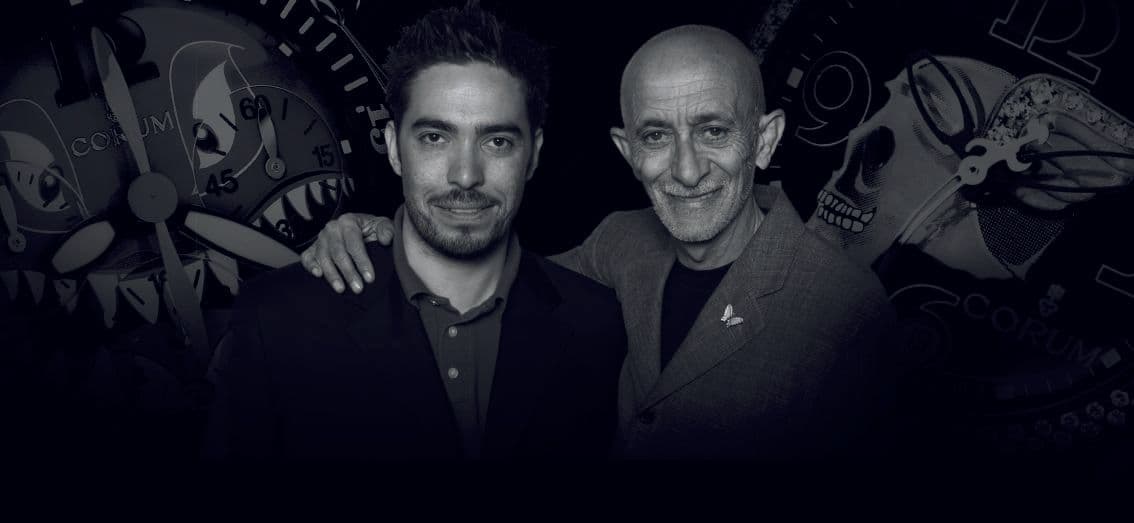
Paris. A nineteen-year-old is directing the campaign shoot for Gucci Timepieces. He is not observing from the sidelines. He is the Marketing Director, coordinating one of the most successful product launches in the history of licensed luxury watches, managing everything from the visual identity to countertop presentations, packaged boxes, and major retail relationships with clients like Macy's, Harrods, and Selfridges. The year's "G" watch will become a global phenomenon. And the young man running it grew up with watch movements on the kitchen table the way other kids grew up with board games.

Michael Wunderman did not choose the watch industry. He was born into it. That distinction matters, because it explains everything that follows: a sensibility forged by decades of living inside the mechanics of desire, a fifteen-year immersion that served as unmatched preparation, and the conviction that what the world needs now is something it has never seen before.
To understand House of Wunder, you have to understand the man who made it inevitable.
Severin Wunderman was defined by an extreme love for the finer things and an unyielding will to manifest the impossible. An astute businessman and an obsessive collector of art, he amassed the largest private collection of Jean Cocteau works in the world. He possessed an artistic desire that found its true expression in watch design. He was told countless times what he could not do. Invariably, he proved the skeptics wrong. Whether building spectacular homes, collecting world-class art, or fishing in quiet solitude, he followed his heart with a singular vision.
A chance encounter with Aldo Gucci changed his destiny. Gucci was famously difficult, yet he trusted Severin in a way he trusted almost nobody. Their partnership became the foundation of Severin Montres, the company that would redefine licensed luxury watches. In those early years, Severin traveled from store to store with his first designs, sleeping with the collection strapped to his body in fear that someone might steal it. What looked like a hustle was already the beginning of an empire.
The stories from that era read like fiction. He went behind his employer's back to place the Gucci order because it was "too big" for the company to handle, then persuaded Gucci to advance the production financing. When Gucci faced financial difficulties in the late 1980s, his royalties kept the house afloat for years. He pioneered steel-and-diamond watches by convincing Rolex's own diamond setters to work with him at a time when the industry believed steel was impossible to set. He created icons, including the pendant-turned-bangle design that evolved into the Model 1100 series, a classic so enduring that Gucci re-released it in 2025. He scaled a single opportunity into more than one million watches a year across over six thousand points of sale. He proved that a fashion house could offer Swiss Made quality before any other brand in the category succeeded.
Unknown to the world during his lifetime, Severin also created the Change a Life Foundation, anonymously giving away millions to those in need. This was revealed only after his death. He was a founding donor of the Shoah Foundation, receiving its Humanitarian of the Year Award in 2001. In 2005, he received the Legion of Honor for donating his vast Cocteau collection to France. The public saw the businessman. Those close to him knew a man whose generosity was as fierce as his ambition.
This was the man who raised Michael. This was the standard.
Growing up inside this world meant something specific. It meant understanding, before you could articulate it, that a great watch is not a product. It is a relationship between obsession and desire. Michael was raised in Los Angeles, schooled at boarding school near London, and exposed early to a cosmopolitan sensibility that would define his creative instincts. But the real education happened at home and inside the business, working every department to learn every aspect of the trade.
At nineteen, he was appointed Marketing Director of Gucci Watches. He went on to run the UK division during the Tom Ford era, a period so explosive that watches sold out globally. He traveled to fifty countries in a single year with a gold collection handcuffed to his wrist. Fifteen years of total immersion: sales floors and campaign sets, packaging details and retail negotiations, the daily texture of what it means to build a luxury brand from the inside.
When the Gucci contract ended, Michael and his father purchased Corum. This was a different challenge entirely. Corum had an extraordinary heritage but needed reinvention, not just scale. Michael immersed himself in the atelier, working side by side with watchmakers, designers, and craftsmen. He modernized icons like the Admiral's Cup and the Golden Bridge. He turned previously unsellable pieces into successes through pure creative repositioning, developing dials, case variations, and limited series that moved from concept to sellout through design vision alone. By twenty-eight, he was President and Creative Director. Under his leadership, the brand reached record sales.
It was during this era that father and son's instinct for the zeitgeist became most visible. Together, they developed Wunderkammer: a subversive jewelry project built on heavy skull motifs, gothic elements, and a raw, unfiltered aesthetic that anticipated the rock-and-roll luxury movement years before the industry caught on. The collection never launched, but it remains proof that the creative DNA behind House of Wunder has always been ahead of its time.
Severin passed shortly after Michael returned to the United States. The market collapsed. The company was sold. An era ended.
But the instinct did not die. Michael expanded into film, architecture, and design, but the one idea that had followed him through every chapter of his life kept pulling him forward. Watches and jewelry should not follow convention. They should challenge it.
In 2021, he returned to watchmaking. Los Angeles. Obsessive prototyping. Hundreds of iterations. Designs that refused to resemble anything else on the market. The brand was formally founded in 2023. Then came the devastating fires that swept through Los Angeles, destroying his home and forcing a relocation to Palma de Mallorca. A lesser conviction would have died somewhere in that sequence. This one only got sharper.
House of Wunder is not a brand with an interesting backstory. It is the product of a lifetime spent inside the creation of extraordinary objects, and the hard-won understanding of what it takes to build something that endures. The brand fuses captivating intensity with Swiss obsession to detail, creating wearable pieces of art that become an integral part of each wearer's personality.
Its first watch, the Amplifier, is the tangible expression of this philosophy: bold, sculptural, sensual, and mechanically intricate, with Art Deco inspiration drawn from the art that surrounded Michael in his family home. It is designed to move with the wearer and evolve with their life.
Everything Severin built, every lesson from Gucci, every innovation at Corum, every experiment in the Wunderkammer: it all converges here. A continuation of a family that has shaped the industry for five decades. A brand born from legacy but driven by the desire to create something that has never existed before.
The refined expression of your wildest dreams. Refine your wild.